In the world of early American horology, genuine survivals from the Colonial era are scarce—and watches signed by known makers working in the South are rarer still. This verge fusee pocket watch, signed James Jacks, Charlestown (Charleston), South Carolina, 508, is an exceptional example: a beautifully made, highly distinctive timepiece that speaks not only to craftsmanship, but to the ambitions and technical curiosity present in eighteenth-century South Carolina.
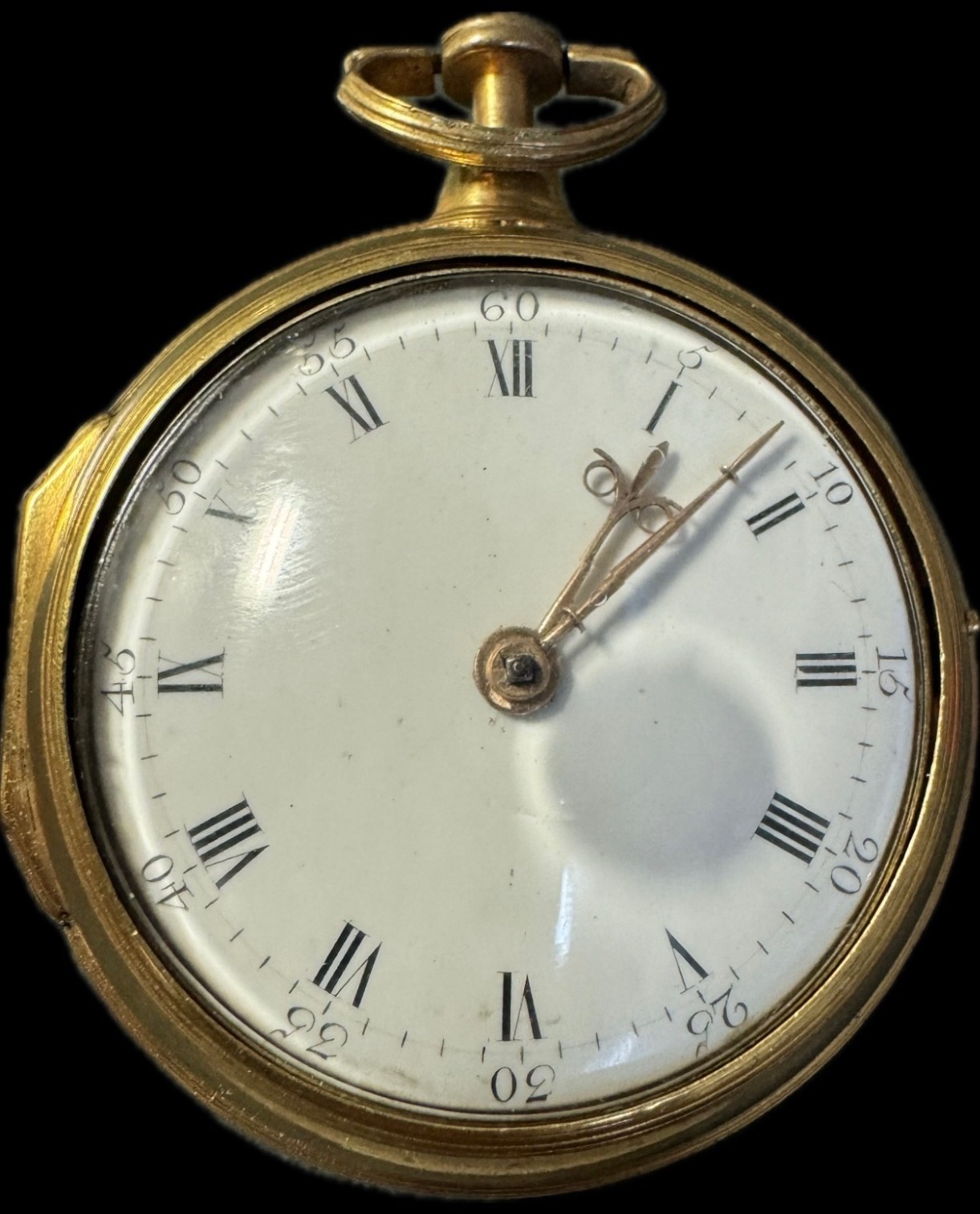
At first glance, the watch feels strikingly refined. The white enamel dial is laid out with Roman hour numerals and an outer ring of minute markings, giving it the clean, high-contrast readability that was prized in late-eighteenth-century pocket watches. The delicate pierced hands add a subtle decorative flourish without sacrificing legibility. Even with the gentle softening that centuries can bring—tiny specks, faint wear, the visual patina of age—the dial retains a quiet elegance that immediately signals authenticity and long preservation rather than modern restoration.
Opening the case reveals the watch’s true centerpiece: a verge fusee movement—an early form of watch mechanism that predates the widespread adoption of the lever escapement. In a verge watch, timekeeping is governed by a balance and a crown wheel escapement, a system that was technologically mature by the 1700s and remained common for much of the century. The inclusion of a fusee—a conical pulley used with a chain—was a vital refinement. Because a mainspring delivers stronger power when fully wound and weaker power as it unwinds, the fusee helps equalize that force, improving consistency across the run of the watch. It is a wonderful reminder that even in 1784, watchmakers and their clients valued precision enough to incorporate sophisticated solutions to real mechanical problems.
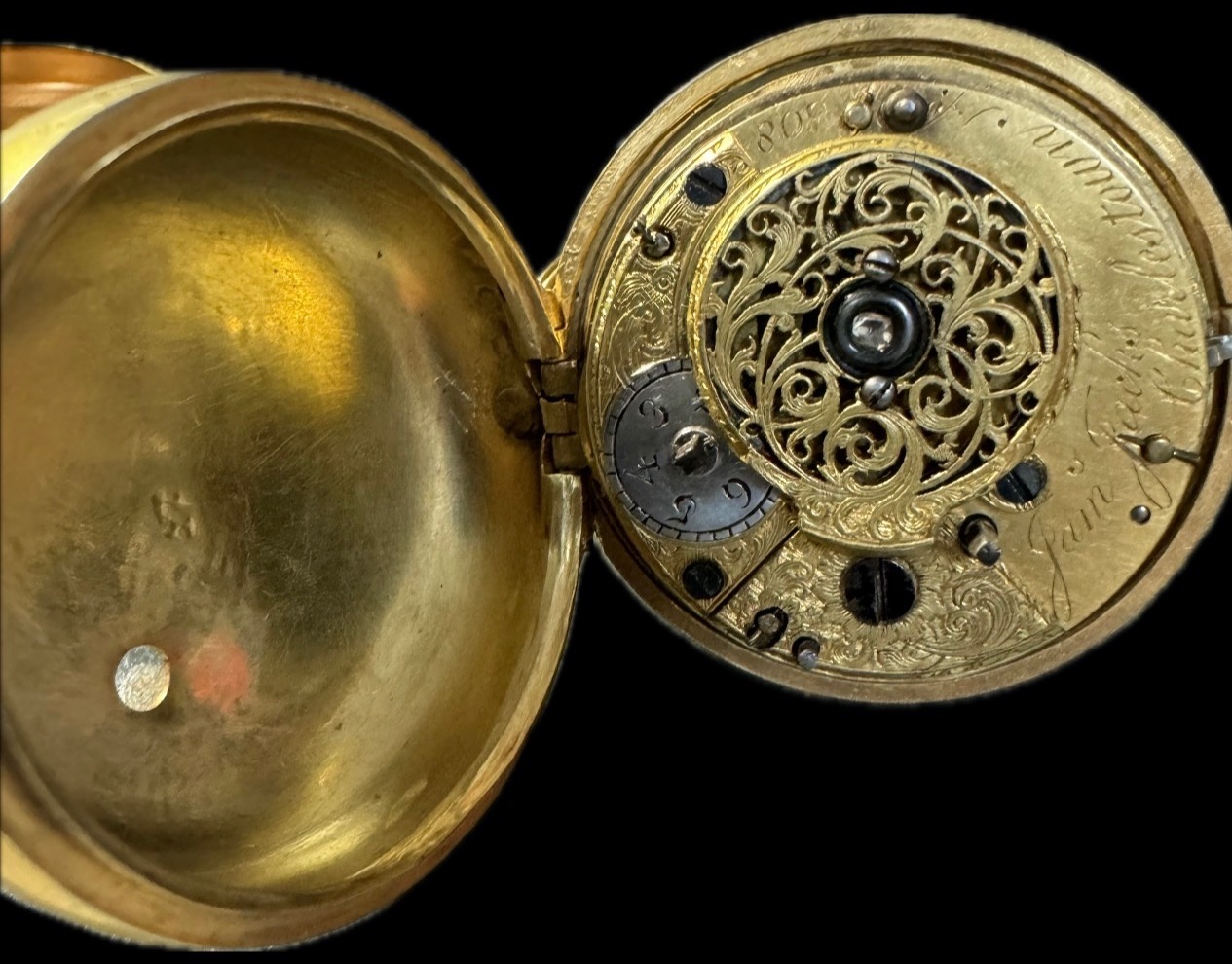
This particular example is further distinguished by a feature called out as especially rare: a three-jeweled verge fusee movement. Jeweling—using hard, low-friction stones at critical pivot points—reduces wear and improves efficiency. While jeweled bearings are a hallmark of later high-grade watchmaking, jeweled verge movements are far less common, particularly in early American-signed watches. The jeweling here is not merely a technical detail; it is evidence of a maker reaching for durability and quality at a time when such refinements were neither inexpensive nor routine.
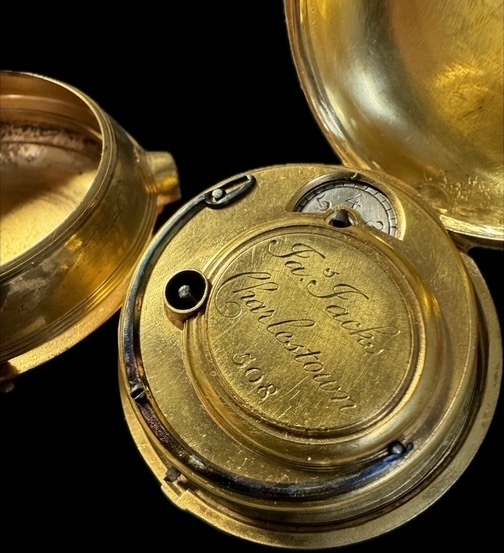
Visually, the movement is also a delight. The plates and bridges carry rich gilt surfaces and fine engraving, and the pierced, scrolling work around the balance area gives the mechanism an almost architectural character—functional parts framed like ornament. Along the perimeter, the signature and location are proudly presented, tying the mechanics to a specific hand and place: James Jacks of Charlestown. Inside, the matching engraving—“Jas. Jacks / Charlestown / 508”—reinforces that sense of identity and provenance, as though the maker intended the watch to announce itself every time it was opened.
James Jacks is recognized as a clock, watch, and scientific instrument maker, and that broader identity matters. In the eighteenth century, the boundaries between watchmaking, clockmaking, and instrument work often overlapped. Skill with fine mechanics, careful calibration, and precision finishing could translate from a clock movement to a surveying instrument—or to a watch compact enough to ride in a pocket. This watch, both technically ambitious and aesthetically confident, reflects that multi-disciplinary tradition.
Just as compelling as the watch itself is the story of how it has been preserved and shared. The timepiece was donated to The Charleston Museum by NAWCC Chapter 176 member Carol Rice, ensuring that it will not only survive, but be interpreted for the public within the region where it was made. The museum plans to display the watch during an exhibition on the Revolutionary War in South Carolina, placing it in the broader historical world of the 1780s—a period when Charleston was a crucial center of trade, culture, and postwar recovery. After the exhibition, the watch will become part of the museum’s permanent collection, where it can continue to represent the material history of craftsmanship in the state.
Watches, clocks, and scientific instruments made in South Carolina during the eighteenth century are highly sought after today, and for good reason. They are physical proof that sophisticated mechanical work was being done far beyond the better-documented centers of the Northeast and Europe. Each signed piece anchors a narrative of local makers, local patrons, and local taste—while also connecting to global traditions in design and engineering. For museums, such objects help tell a fuller, more geographically complete story of early American life. For collectors, they represent an intersection of rarity, artistry, and documented place.
This 1784 James Jacks verge fusee watch stands as a small but powerful survivor: a precision instrument, a personal possession, and now a public artifact. Its dial still presents time with quiet clarity; its movement still showcases the ingenuity of early watchmaking; and its signature still names a maker working in Charlestown at a formative moment in American history. Alongside its exhibition context, it becomes more than a watch—it becomes a tangible link to the South Carolina of the Revolutionary era, measured out in minutes, gears, and gilded brass.